
If you’re trying to straighten your teeth, you’ve probably asked yourself one big question: should you go with clear aligners or traditional braces? Both can give you a straighter smile, but they work very differently — and the right choice depends on your teeth, your budget, and your daily habits.
This guide breaks down the align technology aligners vs braces comparison in simple terms, so you can walk into your orthodontist’s office already knowing what questions to ask.
Quick Answer
Clear aligners are removable, nearly invisible trays that gently shift teeth over time. Braces are fixed metal or ceramic brackets glued to your teeth with wires. Aligners tend to be more comfortable and discreet, while braces usually handle more complex bite problems better. The best choice depends on how severe your alignment issue is and how disciplined you are about wearing removable trays.
What Are Clear Aligners?
Clear aligners are a series of custom-made, see-through trays. You wear each tray for about one to two weeks before switching to the next one in the series. Each tray is slightly different, and together they slowly move your teeth into place.
Because they’re removable, you can take them out to eat, brush, and floss normally. Many adults and teens prefer them because they’re much less noticeable than metal braces.
Who Aligners Work Best For
Aligners generally work well for people with mild to moderate crowding, gaps, or bite issues. They’re also popular with adults who don’t want visible metal in their smile, especially for work or social reasons.
However, aligners require self-discipline. You need to wear them for the recommended hours each day (usually most of the day and night) for them to work properly. If you keep forgetting to put them back in, your treatment can take longer than expected.
What Are Traditional Braces?
Braces use metal or ceramic brackets bonded directly to each tooth, connected by a wire. An orthodontist tightens or adjusts this wire during regular visits, gradually guiding your teeth into the correct position.
Unlike aligners, braces stay on your teeth the entire time. You don’t have to remember to wear them, which removes the compliance issue completely.
Who Braces Work Best For
Braces are often recommended for more complex cases — like severe crowding, significant gaps, or bite problems that need precise, controlled movement. Because they’re fixed in place, orthodontists have more control over exactly how each tooth moves, which is why braces are still the go-to option for complicated cases.
Align Technology Aligners vs Braces Comparison: Key Differences
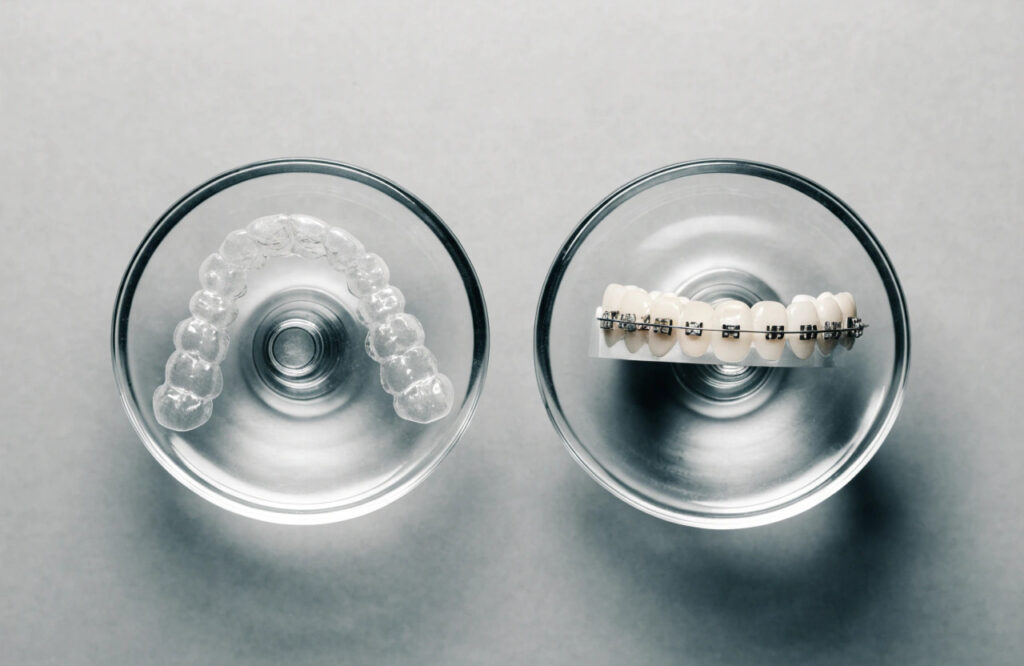
| Factor | Aligners | Braces |
| Visibility | Nearly invisible | Clearly visible (unless ceramic) |
| Removability | Removable | Fixed in place |
| Comfort | Generally more comfortable | Can cause more irritation from wires/brackets |
| Eating restrictions | None (remove before eating) | Some food restrictions apply |
| Best for | Mild to moderate cases | Mild to complex cases |
| Daily responsibility | High (must wear consistently) | Low (no removal needed) |
| Oral hygiene | Easier (remove to brush/floss) | Requires more careful cleaning around brackets |
This table gives you a quick snapshot, but your orthodontist will always be the best judge of which option fits your specific teeth and bite.
Step-by-Step Guide: How to Decide Between Aligners and Braces
- Get a professional evaluation first. Don’t guess based on what you see online — an orthodontist needs to examine your teeth, bite, and jaw alignment.
- Be honest about your daily habits. If you know you’ll forget to wear removable trays consistently, that’s important information for your decision.
- Consider your lifestyle. Think about your job, social life, and how comfortable you are with visible metal on your teeth.
- Ask about your specific case. Some bite issues simply respond better to one method over the other.
- Compare cost and insurance coverage. Ask your provider what your insurance covers for each option, since this can vary.
- Discuss expected treatment time. Ask how long each option might take for your particular case, since it can differ from person to person.
- Make your decision with your orthodontist, not based on trends or what a friend chose.
Common Problems or Mistakes People Make
- Choosing aligners without checking case complexity. Not every smile is a good match for aligners, and forcing the wrong treatment can slow progress.
- Skipping wear time with aligners. Removing trays too often for eating, talking, or “just a little while” adds up and delays results.
- Ignoring oral hygiene with braces. Food can get stuck around brackets and wires, so brushing and flossing need extra attention.
- Assuming aligners are always cheaper. Cost can vary a lot depending on your case complexity and provider, so it’s not automatically the budget option.
- Not asking about follow-up visits. Both options require regular check-ins, and skipping them can affect your results.
Helpful Tips for Choosing the Right Option
- Ask to see before-and-after photos of similar cases from your orthodontist.
- If you choose aligners, set phone reminders to help stay consistent with wear time.
- If you choose braces, invest in an orthodontic toothbrush or water flosser to make cleaning easier.
- Always ask about the total number of appointments expected for your treatment plan.
- Don’t be afraid to ask for a second opinion if you’re unsure which option fits your case.
Frequently Asked Questions
Q.1 Are aligners as effective as braces?
For mild to moderate cases, aligners can be just as effective. For more complex bite issues, braces often provide more precise control.
Q.2 Which is cheaper, aligners or braces?
Cost depends on your specific case, provider, and insurance coverage. Neither option is always cheaper — it varies person to person.
Q.3 Do aligners hurt less than braces?
Many people find aligners more comfortable since there are no wires or brackets rubbing against the inside of the mouth, though both can cause some pressure as teeth shift.
Q.4 Can aligners fix severe teeth issues?
Aligners work best for mild to moderate alignment issues. Severe cases often respond better to traditional braces.
Q.5 How long does aligner treatment take compared to braces?
Treatment time depends on how complex your case is, not just which method you choose. Your orthodontist can give you a realistic estimate after an evaluation.
Q.6 Can adults choose braces instead of aligners?
Yes. Age isn’t the deciding factor — the complexity of your teeth and bite matters more than whether you’re a teen or an adult.
Q.7 Which one is better for teenagers?
Both can work well for teens. The decision usually comes down to responsibility level (for wearing aligners consistently) and the complexity of their case.
Final Thoughts
There’s no universal winner in the aligners vs braces comparison — the best choice depends on your teeth, your bite, and your daily habits. Aligners offer a more discreet, removable option for milder cases, while braces provide dependable, fixed control for more complex smiles.
The smartest next step is booking a consultation with an orthodontist who can look at your specific case and recommend the option that will get you the best results with the least hassle.
Author:
M. Ahmad is an SEO and GEO Specialist and the Founder of Careerzon.org, a platform dedicated to career development and professional growth. He helps readers navigate job searching, resume building, career planning, and skill development through clear, practical, and easy-to-follow guidance. Combining his SEO and GEO expertise with a focus on career content, M. Ahmad ensures Careerzon.org delivers helpful, people-first advice that’s easy to find and easy to understand — whether you’re searching on Google or asking an AI assistant.
Also Read
Why Did My Phone Randomly Restart? Real Causes & Fixes
Why Won’t My Phone Turn On? 8 Fixes That Work
Technical vs Technological: What’s the Real Difference?